Apple Inc. started selling its new Mac Pro desktop computer on Tuesday, complete with eye-watering pricing options that can push the cost north of $50,000 (about ₹36 lakh).
The new machine, built in Austin, Texas after Apple got tariff relief from the Trump administration, starts at $5,999 for specifications that some programmers, video editors, and photographers might consider measly. Fully loaded, the computer costs more than $52,000, and that’s excluding the optional $400 ( Rs. 28,000/-) wheels for easily moving the machine around an office.
For some professional users, the cost of Apple’s new computer is just part of doing business. But for most consumers, the Mac Pro’s price is shocking. As one of the most expensive personal computers in the world, some Apple users quickly compared the cost to a car.
The base product includes 256 gigabytes of storage, low for professional computers in the same price range. A 4 terabyte option is an extra $1,400. An 8 terabyte upgrade is coming later, according to Apple’s website, but pricing hasn’t been announced.
To increase the computer’s RAM memory from 32 gigabytes to 1.5 terabytes is $25,000 extra, the main reason the price can exceed $52,000. Apple said a version of the Mac Pro designed to be racked in data centers costs an extra $500 and will launch later. The Mac Pro does not include a display. Apple put a new Pro Display XDR on sale Tuesday for $4,999.
The Mac Pro’s pricing first came into focus in June when the company announced the product and said that a stand to hold the new monitor would cost an extra $999.
The company also said on Tuesday that it is doubling the cash-back offer for the Apple Card on Apple hardware purchases to 6% until the end of the year. That could make such purchases just a little easier.
We know that Realme’s wireless earbuds, the Realme Buds Air, is going to launch on December 17 along with the Realme X2. While we must wait to learn about the price of the smartphone, a Flipkart post (that has since been pulled down) has given us a peek into what the Buds Air might be priced at.
According to the Flipkart post, the Realme Buds Air is going to be priced at Rs 4,999.
As a build-up to December 17, Realme has made a dedicated product page for the Buds Air on its website and they are also giving away a coupon worth Rs 400 what you can use when you buy it. The coupon will be sent directly to your account on December 17.
The Buds Air look uncannily similar to the Apple AirPods and will be launched in three colours – black, white and yellow. The wireless buds will come with built-in voice assistant, one-touch access to Google Assistant and touch controls. They will support Bluetooth 5.0 and sport a 12mm bass boost driver.
The Buds Air will come with a charging case much like the Apple AirPods and Realme says on the product page that the buds will connect when you open the case and support wireless charging.
In-built voice assistant and touch controls are features expected from any truly wireless audio device these days, for other specs we will have to wait till December 17.
Now, Rs 4,999 as spotted on Flipkart, might not be the actual price of the buds on launch, there are possibilities that Realme might revise that price. One thing, however, is certain – like all other Realme products, the Realme Buds Air should fall in the ‘affordable’ category.
The Flipkart listing also mentioned some offers such as a 5% cashback on Flipkart Axis Bank Credit Card and 5% off on Axis Bank Buzz Credit card.
Google has announced a new feature for Gmail users — attach emails in Gmail. So far, users could forward an email to send to other people or group. The feature is initially rolling out to G Suite users and is likely to be available to all users soon.
“We’ve heard from you that there are situations where attaching emails makes more sense than forwarding separate emails, like wanting to forward multiple messages related to a single topic. With this new functionality, you can do exactly that. Sending emails as attachments allows you to write a summary email message to your recipients, and attach the set of supporting emails that recipients can directly open in their mail client,” said Google in a blog post.
Google has announced a new feature for Gmail users – attach emails in Gmail. So far, users could forward an email to send to other people or group. The feature is initially rolling out to G Suite users and is likely to be available to all users soon.
How to send email as attachments
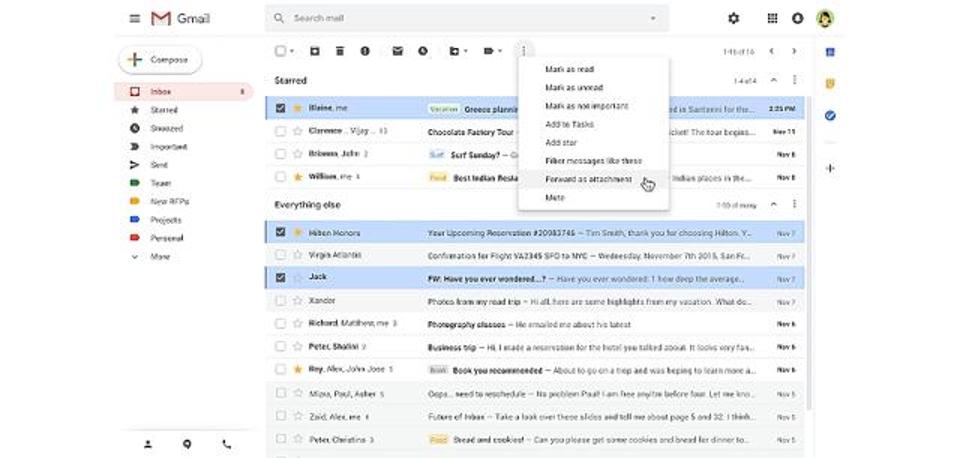
When the feature arrives, you’ll notice a new “Forward as attachment” option in the three-dot menu. Click on that to send email attachment.
Now, go to “To” field, add recipients email IDs. You also have the option to send attachments to people who’re BCCed or CCed.
Note that the attached email is converted into a .eml file. When users click on a .eml file, it opens in a new window.
How to reply with an attached email
Open an email and click on “Reply.”
Next, click on the pop out icon which appears at the top right.
Select the email you want to attach with your reply. Drag the mail into your message.
When will the feature be available?
Gmail has already begun rolling out the feature to G Suite users and should be available in the next two weeks.
“Please note that this feature is rolling out gradually. You’ll know this feature is available to you when you see the “Forward as attachment” option in the three-dot More menu,” added Google.
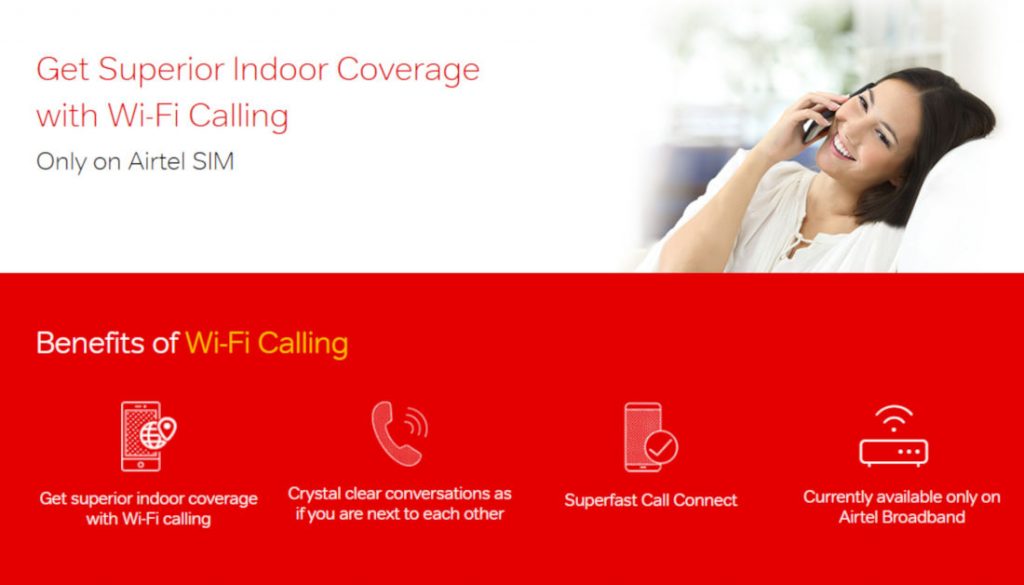
Airtel today launched its Wi-Fi Calling / Vo-WiFi services in India officially starting from Delhi NCR. This lets Airtel users make VoWi-Fi calls in compatible handsets offering improved indoor coverage, faster connectivity and says it will offer crystal clear conversations as if you are next to each other, however it is currently available only when users are connected to Airtel Xstream Fibre network when connected to WiFi.
You need any one of the Wi-Fi Calling Capable Handset and Airtel 4G In Apple go to Settings > Mobile Data > Wifi Calling In Samsung, from the drop-down Quick settings menu enable WiFi Calling In Xiaomi phones go to Settings > SIM Cards & mobile networks > Airtel > Make Calls using Wi-Fi In OnePlus go to Settings > Mobile Network > SIM1/2 > Wifi Calling
After enabling, restart the phone and check for VoWi-Fi symbol in the status bar Airtel Wi-Fi Calling is currently available only in Delhi NCR for Airtel Broadband users, but it will eventually be expanded to other cities gradually.
Airtel said that there will be no extra charge for calls made over ‘Airtel Wi-Fi Calling’ and it consumes minimal data. The service is currently compatible with Airtel Xstream Fiber home broadband and will soon be compatible with all broadband services and Wi-Fi hotspots. You can check out Airtel website for more details.
Commenting on the launch, Randeep Sekhon, Chief Technology Officer, Bharti Airtel said:
As a customer obsessed brand, we are constantly working on improving customer experience based on their feedback. Seamless indoor coverage has been a key ask from mobile customers but getting permissions for site installations has always been a big challenge for mobile operators, particularly in top metros. ‘Airtel Wi-Fi Calling’ is another pioneering technology intervention from Airtel and will go a long way in making the voice calling experience more seamless.
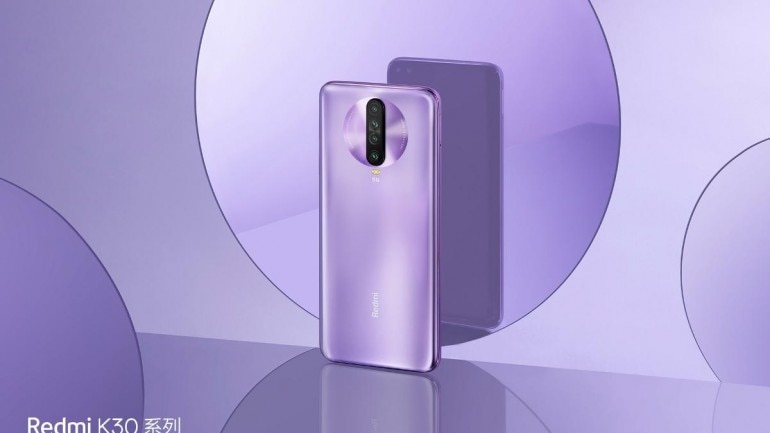
Redmi K30 has been launched as the latest entrant in the Redmi K series that debuted in May. The new Redmi phone is the successor to the Redmi K20 that had a pop-up selfie camera module to deliver a full-screen experience. It also comes in two distinct variants — 4G and 5G. Featuring a 120Hz display, the Redmi K30 is claimed to deliver smooth graphics. The smartphone also flaunts a quad rear camera setup that is designed to capture ultra-wide-angle and macro shots. Further, the Redmi K30 comes with a 3D curved glass body. The Redmi K30 5G also pack 30W fast charging support.
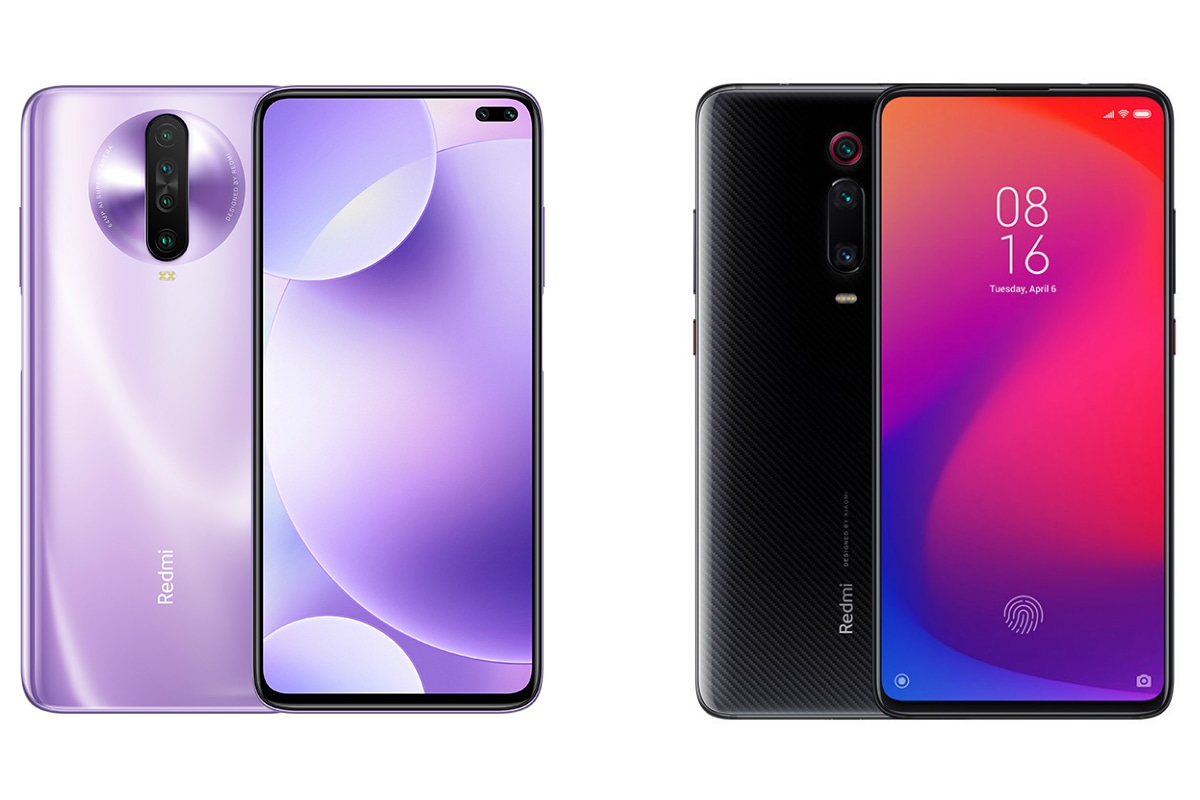
Let’s compare the Redmi K30 with the Redmi K20 to detail all the key differences between the two phones.
Redmi K30 vs Redmi K20: Price
The Redmi K30 price is set at CNY 1,599 (roughly Rs. 16,100) for the base 6GB RAM + 64GB storage variant, while its 6GB RAM + 128GB storage option is priced at CNY 1,699 (roughly Rs. 17,100). The handset also has the 8GB RAM + 128GB storage model at CNY 1,899 (roughly Rs. 19,100) and 8GB RAM + 256GB storage option carries a price tag of CNY 2,199 (roughly Rs. 22,100). It comes in Deep Sea Light, Flower Shadow, and Purple Jade Fantasy colour options.
The Redmi K30 5G price starts at CNY 1,999 (roughly Rs. 20,100) for the base 6GB RAM + 64GB storage variant. The smartphone also comes in 6GB RAM + 128GB storage option at CNY 2,599 (roughly Rs. 26,100), whereas its top-of-the-line 8GB RAM + 256GB storage model carries a price tag of CNY 2,899 (roughly Rs. 29,100). The handset has Deep Sea Light, Time Monologue, Flower Shadow, Purple Jade Fantasy colours.
In contrast, the Redmi K20 was launched in China in May with a price tag of CNY 1,999 (roughly Rs. 20,100) for the 6GB RAM + 64GB storage variant. The smartphone also has the 6GB RAM + 128GB storage option at CNY 2,099 (roughly Rs. 21,100) and 8GB RAM + 256GB storage model at CNY 2,599 (roughly Rs. 26,200). The Redmi K20 debuted in India in July with a starting price of Rs. 21,999 for the 6GB RAM + 64GB storage option, while its 6GB RAM + 128GB storage model is priced at Rs. 23,999.
The phone comes in Carbon Black, Flame Red, and Glacier Blue colour options.
Redmi K30 vs Redmi K20: Specifications
The Redmi K30 and Redmi K20 both have dual-SIM (Nano) support. The smartphones run Android with Xiaomi’s custom MIUI on top. The Redmi K30 comes preloaded with MIUI 11, while the Redmi K20 has MIUI 10 by default, though it’s also upgradable to MIUI 11. On the display front, the Redmi K30 features a 6.67-inch full-HD+ (1080×2400 pixels) display with HDR 10 support, 20:9 aspect ratio, and 120Hz refresh rate. The display panel also has a hole-punch design that matches the display of the Samsung Galaxy S10+. This is notably unlike the Redmi K20 that had a 6.39-inch AMOLED full-HD+ (1080×2340 pixels) display with 19.5:9 aspect ratio and 60Hz refresh rate — without any cutout or hole-punch design.
Under the hood, the Redmi K30 5G variant is powered by Qualcomm Snapdragon 765G SoC, paired with 6GB and 8GB LPDDR4x RAM options. The Redmi K30 4G option, on the other hand, comes with Qualcomm Snapdragon 730G SoC. On the other hand, the Redmi K20 uses Qualcomm Snapdragon 730 SoC, paired with 6GB and 8GB RAM options. The India variant of the Redmi K20 comes with only 6GB RAM, though.
In terms of optics, the Redmi K30 has the quad rear camera setup that includes a 64-megapixel primary Sony IMX686 sensor, paired with an f/1.89 lens. The camera setup also consists of an 8-megapixel secondary sensor with an f/2.2 ultra-wide-angle lens that has a field-of-view (FoV) 120 degrees, 5-megapixel sensor with a 2cm super macro lens that has an f/2.4 aperture and a 2-megapixel depth sensor with an f/2.4 lens. The Redmi K30 4G variant distinctly includes a 2-megapixel macro lens sensor in place of a 5-megapixel one available on the 5G model. Whereas, the Redmi K20 packs a triple rear camera setup that includes a 48-megapixel primary Sony IMX582 sensor along with an f/1.75 lens, a 13-megapixel secondary sensor with a wide-angle lens, and an 8-megapixel tertiary sensor with an f/2.4 lens.
For selfies, the Redmi K30 has a dual selfie camera module that sits on top of the hole-punch design and includes a 20-megapixel primary sensor and a 2-megapixel secondary sensor. The Redmi K20, on the other hand, houses a pop-up selfie camera module that includes a 20-megapixel sensor.
Both Redmi K30 and Redmi K20 are offered in 64GB, 128GB, and 256GB UFS 2.1 onboard storage options.
Connectivity options on the Redmi K30 included 4G VoLTE, 5G (optional), Wi-Fi 802.11ac, Bluetooth v5.1, GPS/ A-GPS, NFC, USB Type-C, and a 3.5mm headphone. The Realme K20 also had a similar list of connectivity options — sans NFC and 5G support.
The Redmi K30 and Redmi K20 both come with an in-display fingerprint sensor. Other sensors on both phones are also quite similar, including accelerometer, ambient light, and gyroscope among others.
Xiaomi has provided a 4,500mAh battery on the Redmi K30. The 5G variant has 30W fast charging support, while the 4G model comes with 27W fast charging. However, the Redmi K20 included a 4,000mAh battery with 18W fast charging support.
The Redmi K30 measures 165.3×76.6×8.79mm and weighs 208 grams. In contrast, the Redmi K20 measures 156.7×74.3×8.8mm and weighs 191 grams.
REDMI K30 5G VS REDMI K30 VS XIAOMI REDMI K20 COMPARISON
Xiaomi’s Redmi brand just announced the Redmi K30 5G and 4G versions at an event in China, as it had promised. It packs a 6.67-inch Full HD+ 120Hz LCD screen with 4.38mm, dual-punch-hole screen with 91% screen-to-body ratio, thanks to 4.25mm ultra-narrow bottom frame. The K30 5G is the world’s first phone to be powered by the latest Snapdragon 765G with support for built-in 5G stand alone and non-stand alone (SA/NSA) s99ub-6GHz networks. The Redmi K30 4G is powered by Snapdragon 730G instead of Snapdragon 765G and lacks 5G support.
Redmi K30 and K30 5G launched
It has 5mm copper tube liquid cooling to the temperature of the phone by up to 7 degrees, and runs Android 10 with MIUI 11 on top. The K30 is also the world’s first smartphone to pack Sony IMX686 64-megapixel 1/1.7″ sensor, and it has an 8-megapixel ultra-wide-angle lens, 5-megapixel (2-megapixel in K30) 2cm super macro and a 2-megapixel camera for portrait shots. On the front there is a 20-megapixel camera along with a secondary 2-megapixel camera for portait shots.
The phone has a 3D curved frosted glass body with Corning Gorilla Glass 5 protection, side-mounted fingerprint scanner and packs a 4500mAh battery with 30W Flash Charge fast charging with new charging architecture with charging conversion efficiency of up to 97% that can charge the phone in 1 hour, while the K30 4G comes with 27W fast charging.
The Redmi K30 comes in White, Blue Red and Purple colors. The Redmi K30 4G version will be available in China from December 12th and the Redmi K30 5G will go on sale from January 2020. Pricing as follows.
K30 5G — Octa Core (1 x 2.4GHz + 1 x 2.2GHz + 6 x 1.8GHz Kryo 475 CPUs) Snapdragon 765G 7nm EUV Mobile Platform with Adreno 620 GPU
K30 4G — Octa Core (2.2GHz Dual + 1.8GHz Hexa) Snapdragon 730G 8nm Mobile Platform with Adreno 618 GPU
6GB LPDDR4X RAM with 64GB / 128GB (UFS 2.1) storage, 8GB LPDDR4X RAM with 128GB / 256GB (UFS 2.1) storage expandable memory up to 512GB
Android 10 with MIUI 11
Hybrid Dual SIM (nano + nano / microSD)
64MP rear camera with LED Flash, Sony IMX686 sensor, 0.8μm, f/1.89 aperture, 8MP 120° ultra-wide sensor with 1.12μm, f/2.2 aperture, 2MP depth and 5MP (2MP in K30) macro sensors with 1.75μm, f/2.4 aperture, 4K 30fps, 960 fps at 720p
20MP front-facing camera, 2MP secondary camera with 1.75μm for portrait
Side-mounted fingerprint sensor, IR sensor
3.5mm audio jack, FM Radio, 1217 Linear Speaker, Smart PA
Dimensions: 165.3×76.6×8.79mm; Weight: 208g
Dual 4G VoLTE, WiFi 802.11 ac (2.4GHz + 5GHz), Bluetooth 5, Dual-frequency (L1+L5) (K30 5G), GPS/GLONASS/Beidou, NFC, USB Type-C
4500mAh (Typical) / 4400mAh (Minimum) battery with 30W (K30 5G) flash / 27W (K30) fast charging
Earlier this week, Airtel and Vodafone Idea hiked prepaid tariff and released new recharge plans. Following Reliance Jio’s announcement regarding tariff hike recently, the company has now officially launched the ‘New All-in-one plans‘ with revised pricing along with JioPrime benefits.
Similar to Airtel and Vodafone Idea, Fair Usage Policy applies on unlimited calling from Jio to other networks, and users will be charged 6 paise/min post FUP. Users won’t be charged 6 paise/min for Jio to Jio calls.
Jio’s revised plans are categorized into 1-month, 2-month, 3-month, 12-month, and “Affordable plans”. Here is the list of ‘new All-in-one plans’ from Jio
Jio is also bundling JioPrime benefits including access to JioTV
JioCinema, JioSaavn, JioNews, JioSecurity, JioCloud, and JioHealthHub. These new plans will be available starting 6th December 2019 and can be opted from all existing touchpoints.
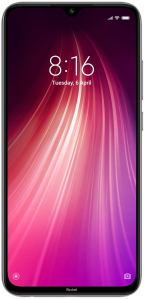
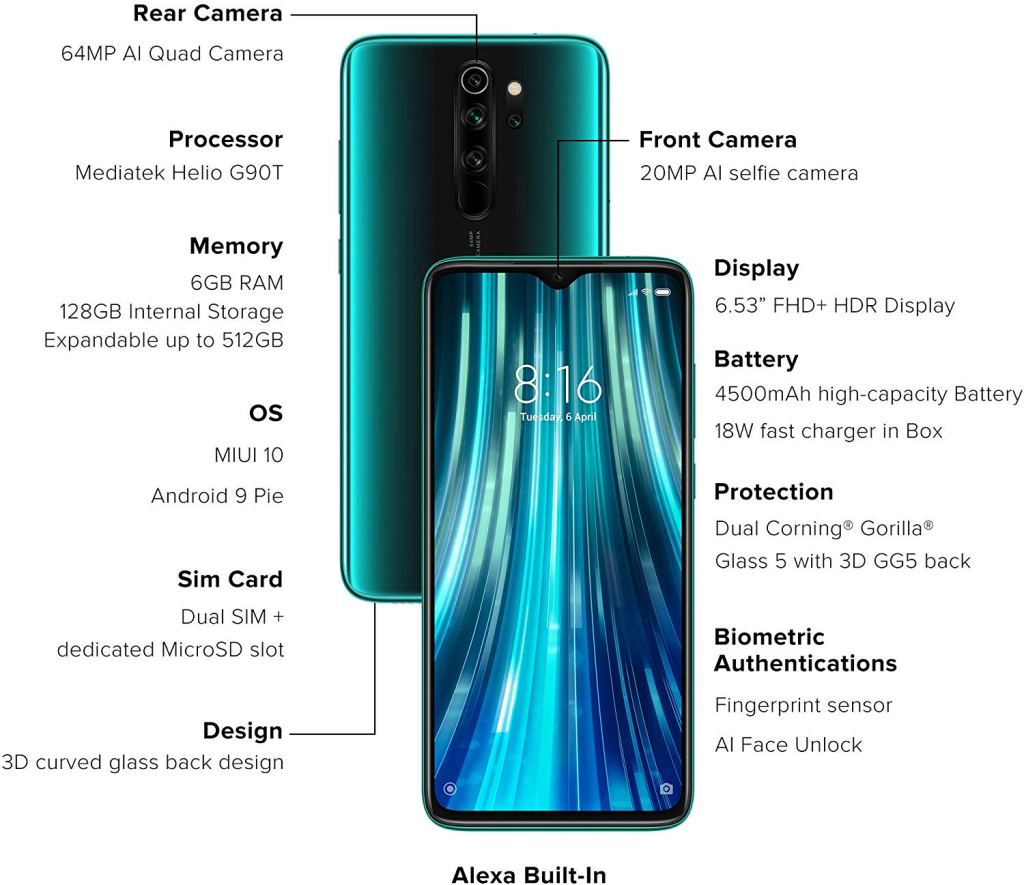
Redmi Note 8 and Redmi 8 phones made available will go for sale again. The sale of these two will start from 12 noon. Redmi Note 8 will be sold from Amazon, Xiaomi’s website and Mi Home stores.
While customers who want to buy Redmi Note 8 Pro will have to wait for 11 December.
The price of Redmi Note 8 has been kept at Rs 9,999 in India. This price will be of the base variant with 4GB RAM + 64GB storage. At the same time 6GB RAM + 128 GB has been kept at Rs 12,999 in India.
Redmi 8 right there will be made available on sale from Flipkart, Xiaomi’s website and Mi Home stores.
On the other hand, talking about Redmi 8, its initial price base variant 3GB RAM + 64GB was kept for 7,999 rupees . At the same time, the cost of 4GB RAM + 64GB storage launched for Rs. 10,999/- is also available for 7,999 rupees available via Flipkart.
The first five million units of the variant are being sold at an introductory price of Rs 7,999. These phone customers will receive Emerald Green, Onyx Black, Ruby Red and Sapphire will be available in blue color option. Customers will also be able to buy it from 12 noon today.
Redmi 8 has a 6.22-inch HD + (720×1520 pixels) display with Gorilla Glass 5 protection, Qualcomm Snapdragon 439 processor, storage up to 64GB, 12MP primary camera, 8MP selfie camera and a large 5,000mAh battery.
Customers who want to buy Redmi Note 8 Pro will have to wait for 11 December.
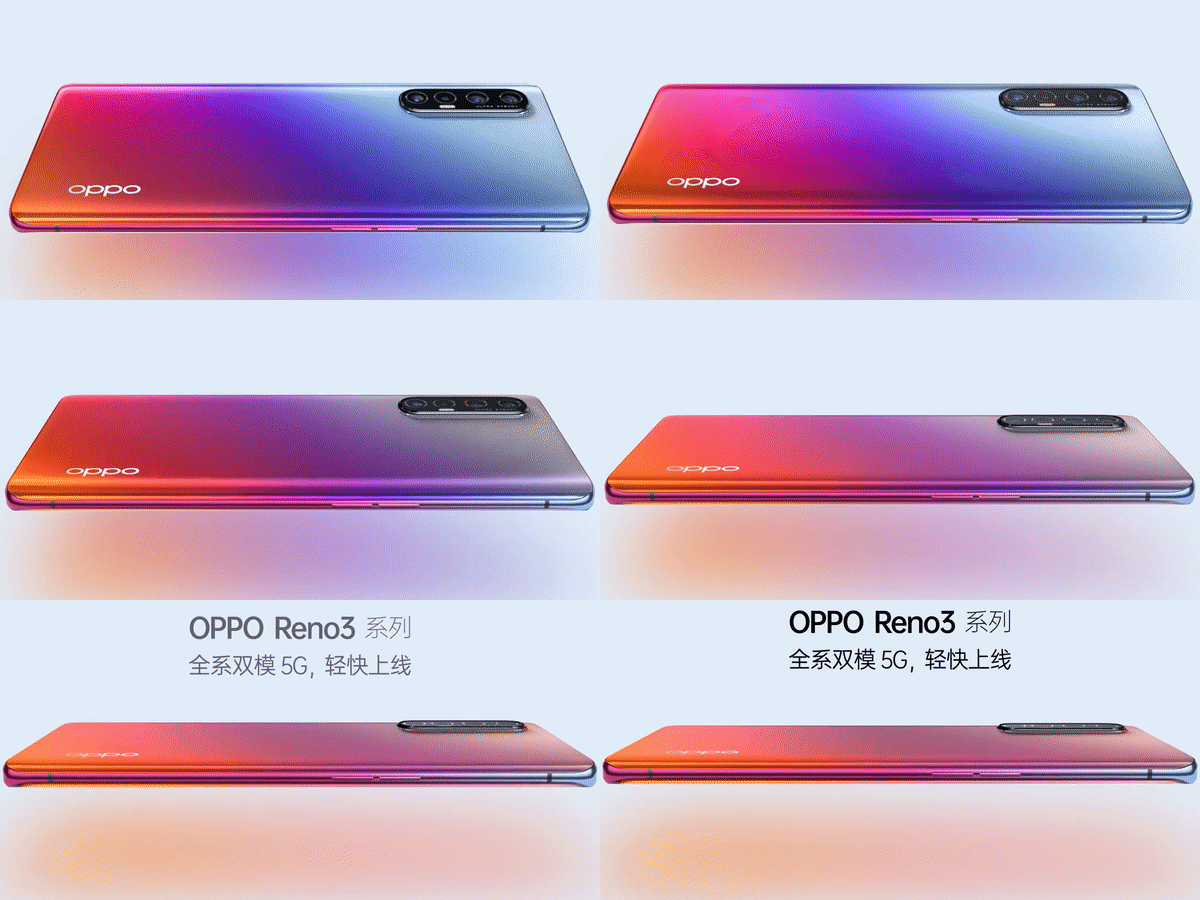
OPPO has posted a new video teaser for the Reno3 Pro showing off its quad rear cameras, metal frame and glass back with a gradient finish. Both the phone have a similar rear camera arrangement, but the position of the LED flash is different. However, only the Reno3 Pro has a punch-hole screen on the left side, while the Reno3 features a water-drop notch screen with a slightly bigger bottom bezel.
As per latest Update OPPO Mobile VP has confirmed that the phone will pack a 4025mAh battery and weigh 180 grams.
A first look at OPPO Reno3 Pro 5G – it will feature a glass body with a thickness of just 7.7mm (excluding the lens), which may just be the thinnest dual-mode 5G phone in it’s price segment. 👀 pic.twitter.com/KD9goOTD6b
Earlier OPPO launched the Reno 2 smartphone in India back in August this year and the company is already all set to launch the successor to Reno3 next month. Now, OPPO has also posted teaser of the Pro version of the Reno3 – OPPO Reno3 Pro 5G revealing the design of the smartphone.
According to the image posted by OPPO Mobile Vice President, the Reno3 Pro 5G will sport a no-notch display with curved edges, glass body with 7.7mm thickness excluding the lens. Although the image doesn’t reveal the front camera, OPPO could either include an in-screen camera to the top-left.
Rest of the specifications off OPPO Reno3 Pro 5G is not known yet. But, it is confirmed to come with ColorOS 7 out of the box and 5G support. We should know more information once more teasers are out officially in the coming days.





















 GeekSpot